
Driveway & Pavers Near Me: How to Choose a Local Construction Company in Grand Prairie
Search “driveway pavers near me” in Grand Prairie and half the results are lead-generation sites, not contractors. They collect your name and address and sell it to multiple subs, none of whom answer for what the other does on your property. A few clicks later you have five calls and no way to tell who’s actually building your driveway. Here’s how to separate the real installers from the middlemen before you pick up the phone.
If you’d rather skip the sorting entirely, call (844) 771-4071 and we’ll talk through your project. Estimates are free.
How do you spot a lead aggregator versus an actual contractor?
A lead aggregator sells your contact details. A real contractor shows up, measures your driveway, and quotes the work. The two can look identical in a search result, so check these signals before you share your address.
- The URL looks like a directory. Pages built around a keyword plus a city (“grand-prairie-driveway-pavers.com”) with no company name attached are usually lead capture. A real local contractor typically uses their own business name in the domain.
- The About page never says who they are. If there’s no named company, no service list, and no address, that’s a red flag. A legitimate outfit will tell you what trades they handle and where they work.
- One form, five callbacks. If the only way to reach them is a form and you can’t find a direct phone line, you’re probably filling out a lead sheet, not contacting a builder.
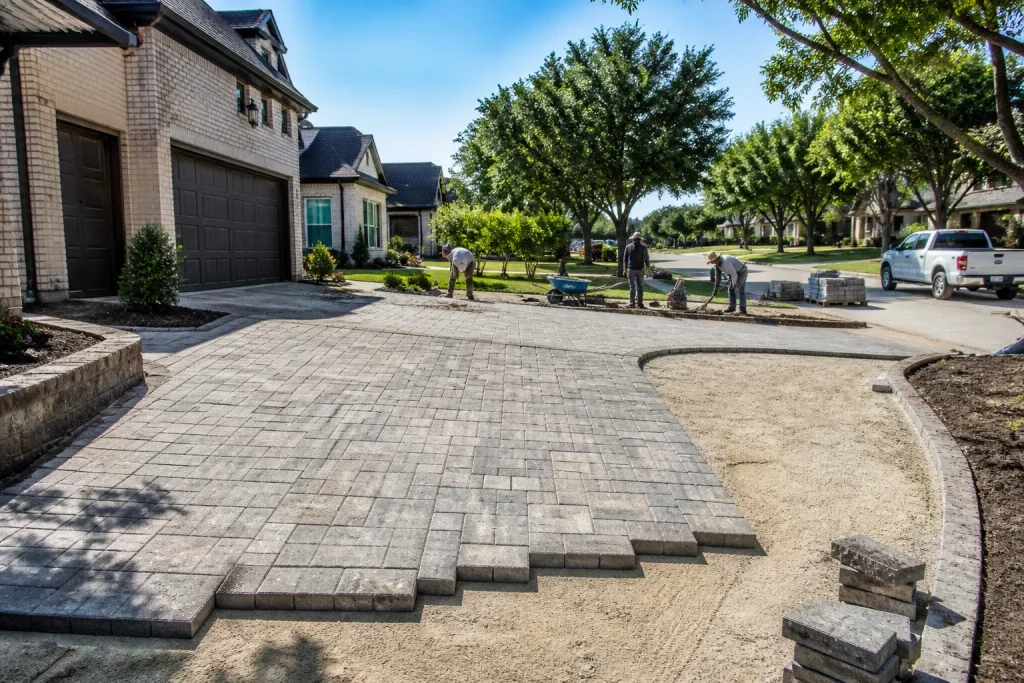
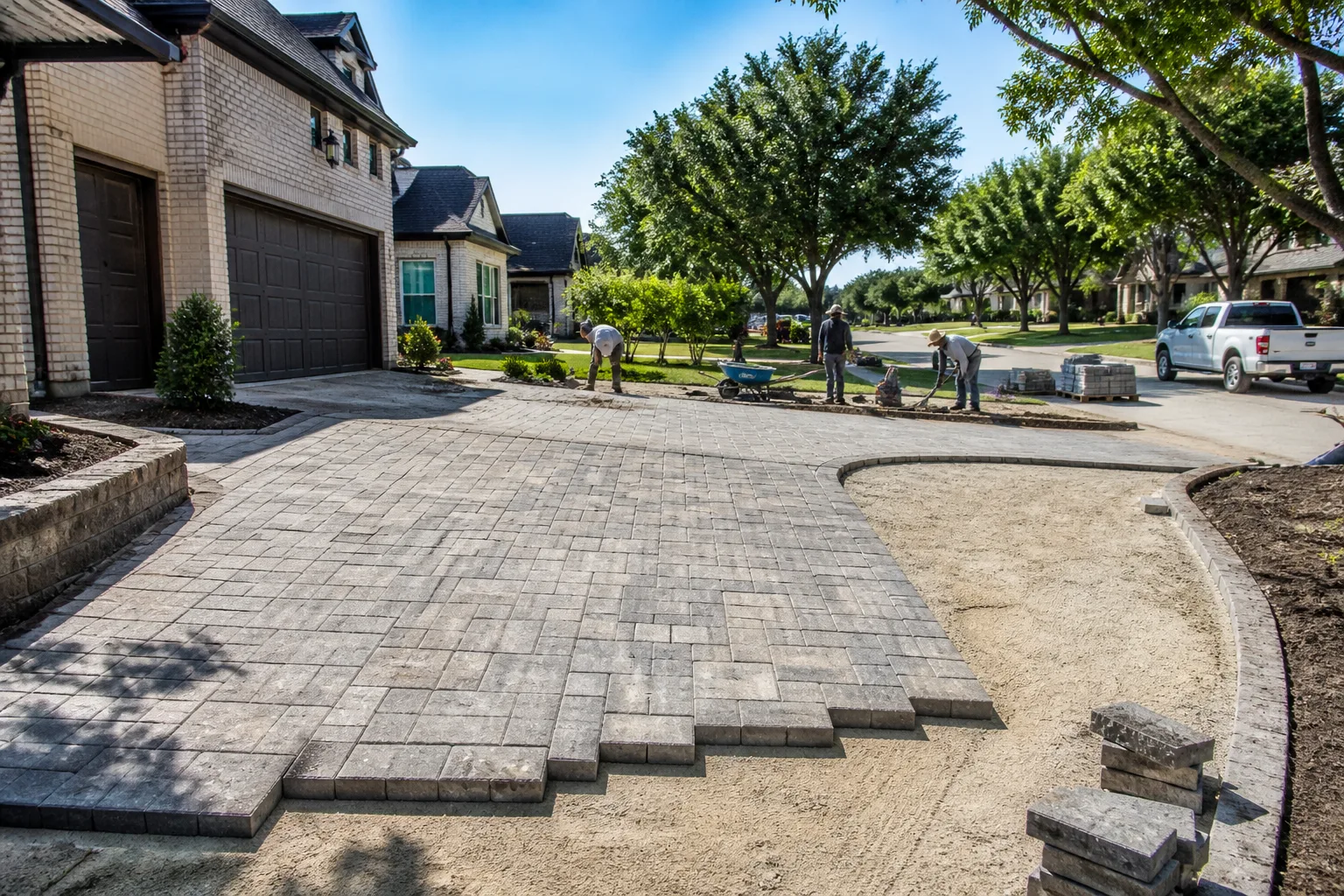
- No portfolio of process photos. Aggregators don’t build anything, so they can’t show base prep, excavation, or compaction stages. They just show stock photos of finished pavers.
- Prices quoted without a visit. A real paver quote requires measuring square footage, checking slope, and looking at existing drainage. Anyone who gives you a number over the phone without seeing the site is guessing, or worse, baiting.
Spend five minutes on these checks. It’s the difference between a written estimate from a builder and a week of cold calls from subs who never saw your property.
Why does a paving-only sub create accountability gaps in Grand Prairie?
Paver driveways rarely exist in isolation. There’s typically drainage to manage, curb transitions, a tie-in to existing concrete, and landscaping that borders the work. When a paving-only sub handles just the surface, everyone else’s scope becomes someone else’s problem.
Here’s how that plays out in Grand Prairie. The paver crew sets their base and finishes their run. The gutter and drainage work was quoted separately by another company. The landscaper shows up three weeks later and finds that the pavers sit two inches higher than the adjacent concrete walkway, or that the grading sends water toward the garage instead of the street.
Now you’re making calls. The paver sub says the grading was someone else’s job. The landscaper says the pavers were set too high. The concrete contractor is long gone. You’re stuck in the middle, and the fix comes out of your pocket.
A full-scope contractor closes that gap. When one team handles grading, drainage, curbing, and paving under a single contract, there’s one point of accountability. If something needs adjustment, there’s no finger-pointing round-robin. That’s why, in our experience, driveway projects that run smoothly tend to be the ones where a single company holds the whole scope, including how the driveway meets your fence line, your walkway, and the grade of your yard.
What five questions reveal whether a contractor actually knows Grand Prairie?
The first call tells you a lot. Ask these five questions and listen carefully to the answers. A contractor who genuinely works in Grand Prairie will answer them specifically. A company reciting a generic pitch won’t.
- “How do you handle drainage on a driveway with a slope toward the house?” A real answer involves base preparation, grading, and sometimes a channel drain or swale. A vague answer like “we just slope it away” tells you they haven’t thought it through.
- “What base thickness do you use under pavers, and why?” Proper paver installation depends on a compacted aggregate base sized for the load and soil. A contractor who can explain their base depth and compaction process knows what they’re doing. One who says “it depends” and moves on doesn’t.
- “Do you pull permits for this scope, or do I?” In most cities, certain driveway and hardscape work requires a permit or at least a code check. Ask who’s responsible and whether they’ll walk you through the inspection process.
- “What paver system are you specifying?” Brands like Belgard, Unilock, Techo-Bloc, Tremron, and Cambridge Pavers carry documented load ratings and installation specs. A contractor who names the system and explains why they chose it for your site is working from a spec sheet, not a sales brochure.
- “Can I see photos of your base preparation, not just the finished driveway?” This is the one that separates real builders from surface installers. Base prep photos show excavation, aggregate, and compaction. If the portfolio only shows finished pavers with no process shots, you’re looking at a surface-level operation.
If a company can answer all five with specifics, you’re talking to someone who actually builds driveways in Grand Prairie. If they stumble on three or more, keep dialing.
What should a local portfolio show beyond finished pavement?
A finished driveway photo tells you the design looks good. It tells you nothing about whether the base was compacted properly, whether the edges were restrained, or whether the drainage works in a heavy rain. Process photos fill in the blanks.
Here’s what to look for in a contractor’s portfolio:
- Excavation shots. You should see the old surface removed and the subgrade exposed. That’s the foundation of the job.
- Aggregate and compaction stages. Photos showing the granular base being placed and compacted prove the contractor installs to spec, not just to appearances.
- Edge restraint detail. Paver edges need proper restraint, or the system shifts over time. A photo showing the edge restraint being installed is a good sign.
- Drainage tie-ins. Look for how the driveway connects to gutters, swales, or existing drainage. These are the details that determine whether you have standing water after a storm.
- Transitions. Photos showing how the pavers meet your sidewalk, garage apron, fence, and landscaping tell you the contractor thinks about the whole site, not just the paver field.
We’ve seen installations where the finished surface looked perfect and the base was two inches short. Six months of Texas heat and rain later, the pavers were shifting and the homeowner was calling someone else. Process photos are your best insurance against that outcome.
When should you call a pro instead of doing it yourself?

A paver driveway is genuinely hard work. Excavating the existing surface, hauling and compacting base material, setting screed, cutting pavers, and getting the grade right is a multi-day job for a crew with equipment. If you’re considering DIY, the questions to ask are about drainage, base thickness, and compaction, not about whether you can lay pavers in a weekend.
Call a professional when:
- The driveway slopes toward your house or garage and you’re not sure how to correct it.
- There’s existing concrete to remove or tie into, which requires cutting and proper transitions.
- Your project also involves drainage, grading, a new fence line, or landscaping that borders the driveway.
- You want manufacturer-backed materials with documented load ratings from a system like Belgard or Unilock, not pavers picked up from a big-box aisle without a spec sheet.
A full-scope contractor can handle the driveway, the drainage, and the fence in one contract. If your project also needs a new boundary line before the pavers go in, our fence installation team can coordinate with the paving schedule so nothing gets torn up twice. And if the project grows into something bigger, like adding a garage bay or an ADU alongside the driveway, our home additions & ADU scope runs on the same contract.
Why does one contractor matter for a Grand Prairie driveway project?
Grand Prairie sits on clay-heavy soils that hold water and shift with seasonal moisture. A driveway that doesn’t respect that reality will crack, settle, or pond water within a year or two. That’s a soil condition issue, and it’s exactly why the contractor you choose needs to know the local ground, not just the paver catalogue.
A contractor who knows Grand Prairie soil will talk about base preparation depth, drainage away from the foundation, and how to handle transitions where your driveway meets your slab or garage. They’ll also know that a rigid paver system on a soft base is a shortcut that costs the homeowner later. The same care applies to how you spec everything else around the house. Windows and doors from lines like ES Windows or Therma-Tru, for example, are only as good as the installation behind them. Materials and method matter equally, and one contractor who handles both avoids the blame game when a transition fails.
That’s the value of a full-scope contractor. Your driveway, your fence, your drainage, and the grade of your yard all connect. Handling them under one contract means one team is responsible for how they fit together, and one call handles any adjustment down the line. For the driveway itself, our driveway & pavers page covers the install scope, materials, and what to expect from a written estimate. You can see the full range of what we handle at Construction Grand Prairie.
The Bottom Line
The best way to find a driveway paver contractor in Grand Prairie is to skip the lead aggregators and vet the real ones. Check the URL and About page. Ask five specific questions on the first call. Look for process photos, not just finished pavement. And favor a contractor who can handle the whole scope, from grading and drainage to the fence line and the transition to your house, so you’re not the one playing referee when something needs adjustment.
The written estimate sets the price, and it should be free. If you’re in Grand Prairie and need help, Construction Grand Prairie offers free estimates. Call (844) 771-4071.
We answer 24/7. Fast dispatch from 7am to 7pm, Sunday through Friday. We’re closed Saturday.
Frequently Asked Questions
Paver driveway costs in Grand Prairie vary with square footage, paver system, base prep, and drainage requirements. The only number that matters is the written estimate, and we’ll give you one after walking the site. Call (844) 771-4071 to schedule a free estimate.
Not a reliable one. A contractor who hasn’t measured your driveway, checked the slope, and looked at your drainage is guessing. A written estimate based on a site visit sets the final price, so we don’t quote without seeing the property.
A keyword-heavy URL, no named company on the About page, no direct phone number, and no process photos in the portfolio. These sites collect your information and sell it to multiple contractors who may never have spoken to each other.
No, we’re closed Saturday. We answer 24/7 and dispatch from 7am to 7pm, Sunday through Friday. Call (844) 771-4071.
Written by the team at Construction Grand Prairie.
Need Construction Help?
Call Construction Grand Prairie - the local pro we connect you with is licensed and insured, here with fast help in Grand Prairie.
(844) 771-4071